



Metadata can help researchers examine how coded evidence is distributed across participant or document groups. It is useful for asking where a pattern appears, what differences deserve closer reading, and whether selected evidence represents the full range of cases. It does not turn a qualitative dataset into a statistical test by itself.
Begin with denominators
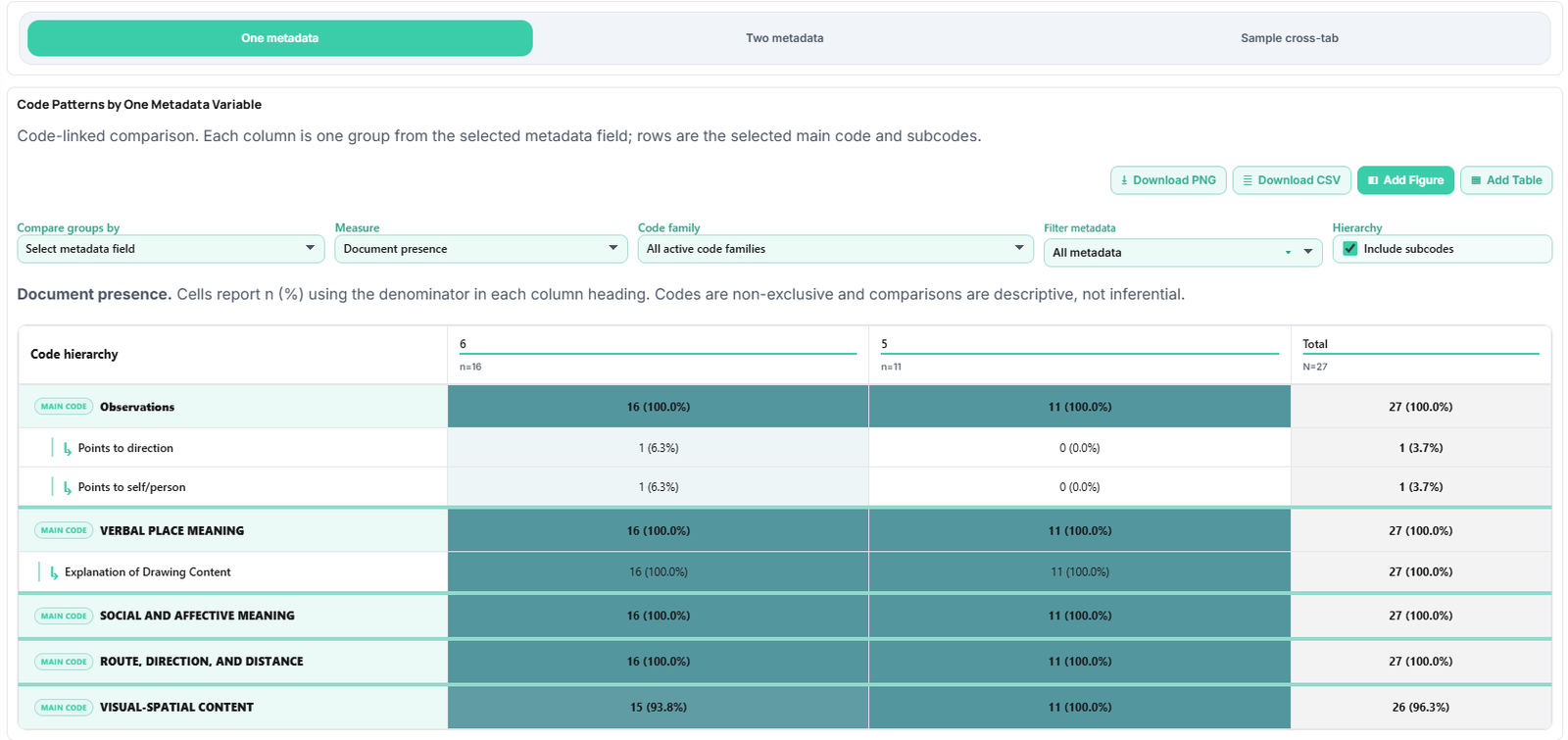
A count of coded segments is hard to interpret without knowing the number of cases, documents, or eligible items in each group. Report the denominator and distinguish document presence from evidence frequency.
Use comparisons to guide reading
A difference can prompt a return to the relevant excerpts, code definitions, and case context. It should not become a claim about an effect of age, gender, role, or location unless the design and analysis support that inference.
Protect small groups
Crossing several metadata variables can make individuals identifiable. Suppress or aggregate combinations where confidentiality is at risk, and label small-cell patterns as descriptive or exploratory.
Questions researchers often ask
Can metadata prove group differences?
No. It can describe distribution and support purposive analytic comparison; it does not establish statistical significance or causality.