

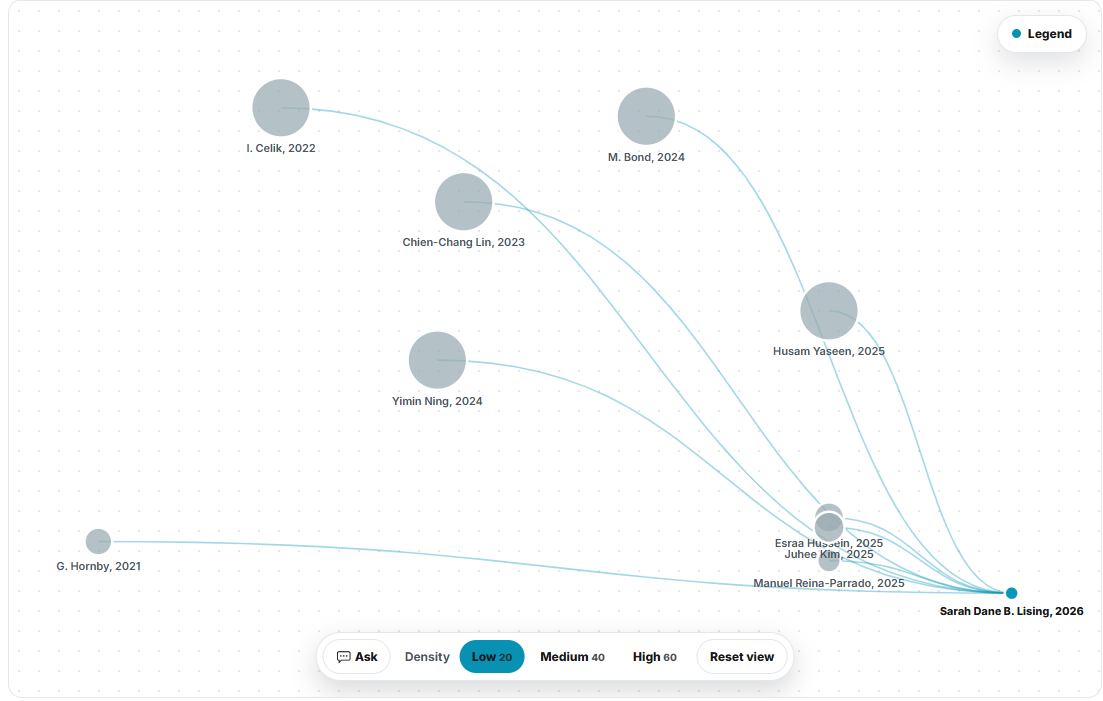
A search result is a useful beginning, but it is a flat view of the literature. It can tell you which papers match a phrase, not how a particular study arrived at its framing or who later took up its contribution. Those are different questions. A citation map makes the second set visible by placing a selected paper inside a local network of references and citations.
A paper has a past and a future
Every paper is written in response to earlier work, whether that work supplies a concept, method, dataset, disagreement, or problem to solve. It also enters a later conversation when other researchers cite it. Reading only a result card makes those two directions easy to miss. Reading both directions turns a paper from an isolated item into a traceable point in a field.
Foundations are not just a bibliography
A reference list is often long enough that readers stop seeing it as an argument. But a paper’s cited foundations can reveal where its concepts came from, which methods it treats as established, and which debates it assumes the reader already knows. The Citation Map Foundations view narrows attention to that immediate reference context. It does not decide which source is most important; it gives you a manageable route for asking better questions of the paper.
Influence is not endorsement
Later citations can be equally informative, but they should not be counted as votes. A paper may be cited because it is useful, contested, historically important, methodologically convenient, or simply mandatory background in a field. The Influence view is therefore best used to identify what to inspect next: newer applications, replications, criticisms, extensions, and adjacent uses. Open the individual paper records before describing any relationship.
Use maps after—not instead of—search
The strongest workflow is sequential. Start with Paper Search to learn terminology and screen candidate studies. Once a paper looks central, distinctive, or methodologically useful, open its graph. Then return to paper records and full texts to test what the map has suggested. Search supplies breadth; mapping supplies relationship context; reading supplies the evidence for your judgement.
Keep the map modest
A citation network is exploratory, not a systematic-review search strategy. Coverage depends on the available records, and a dense graph can create the illusion that visible work is the whole field. Begin with a low-density map, identify meaningful paths, and widen the view only when it serves a clear question. The value is not seeing the most nodes. It is making a better next reading decision.